
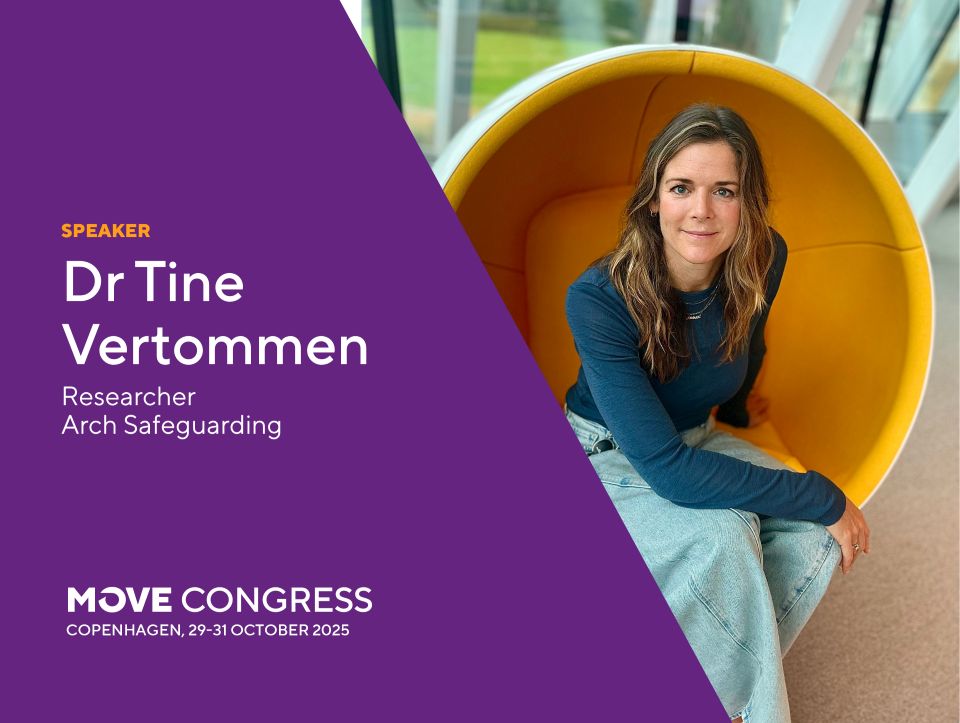
In anticipation of the MOVE Congress, we’re bringing you exclusive interviews with the inspiring speakers who will take the stage in Copenhagen. First up: Dr Tine Vertommen, the founder and Director of the Arch Safeguarding.
 Ahead of her October 30 presentation at 9AM, she maps the way forward and assesses the challenges faced by today’s safeguarding practitioners.
What are the most pressing issues currently facing sports safeguarding today?
One is the normalisation of violent behaviours and boundary transgressions. Practices like verbal humiliation, excessive training workloads, or ignored personal boundaries are too often accepted as part of sports culture rather than being recognised as harmful. However, it is encouraging that awareness is growing, and more open dialogue is taking place.
Although they remain under-represented in decision-making, athletes do have a stronger voice today. Since sport cannot exist without athletes, their perspectives should be placed at the very core of safeguarding work.
What are the greatest obstacles to putting safeguarding measures into practice?
The challenges are twofold. Firstly, the science of safe sport and safeguarding is still evolving. We don’t yet have sufficient evidence in every context to be certain which prevention and response measures are most effective. Secondly, it is an enormous task to ensure that safeguarding efforts reach all the way down to the grassroots. International organisations are making good progress, often supported by professional staff and resources, but translating these advances to national and grassroots sport is much more difficult. Local organisations often have limited capacity and expertise. This remains one of the greatest obstacles to making safe sport a reality.
Given that safeguarding often requires shifting deep-rooted attitudes and behaviours, what are the most effective ways to activate lasting cultural change within sports organisations?
Changing culture is not easy. It takes patience, skill, repetition, and energy. Let’s compare it to trying to turn a huge oil tanker in the middle of the sea. You can turn it, but it won’t happen quickly or without effort. Safeguarding culture requires steady investment and persistence. We need to keep reinforcing the same core messages, modelling safe behaviours, and holding ourselves accountable. With time and consistency, those small shifts accumulate into real cultural change.
How can coaches, parents, and athletes themselves be more proactive agents in creating safe and inclusive spaces?
This doesn’t need to be complicated. It starts with being attentive and human: asking people how they are really doing, listening to their answers, and showing that you care. If you see something, do something, whether that means offering support, asking a question, or reporting a concern. A proactive attitude from bystanders and in social situations makes a huge difference. Everyone has a role to play in creating safe spaces, not just leaders or specialists.
Has the global conversation around athlete welfare and protection shifted in recent years, and what progress or changes have you seen?
We’ve seen significant changes over the past few years. The taboo around abuse and harassment in sport is certainly less than it was before. At the same time, it can still be an enormous barrier for an individual athlete or a small local club. Breaking that taboo remains an ongoing struggle at every level.
Whereas only a few individuals previously worked on this issue, there is now a much broader movement. I’m grateful to see a growing community of safeguarding practitioners, policymakers, sport leaders, academics, and most importantly those impacted by abuse, witnesses and athlete representatives, who are leading the way. Together, they have brought safe sport to the forefront of the international agenda and created a collective voice that is driving change.
The next step is to widen the scope even further. Safeguarding must extend beyond athletes to include coaches, managers, officials, journalists, and workers. We also need to address the emerging risks connected to online forms of violence, which increasingly affect the sporting environment. True safe sport will only exist when everyone involved is protected, both online and offline.
Could you tell us your favourite way to be physically active – whether it is a sport, dance, or everyday movement – and why you enjoy it?
 I enjoy yoga and lifting weights, and I try to sneak out of meetings to do squats behind my desk before the next Zoom call begins. What I love most, though, are daily walks in nature with our dog, Rico. Walking outdoors helps me recharge, stay active, and connect with the world outside of work.
Dr. Tine Vertommen is a leading expert on the prevalence and prevention of interpersonal violence in sport. Holding a MA in Ethics, an MSc in Criminology, and a PhD in Health Sciences, she combines a deep academic background with over two decades of practical expertise.
She is the founder of Arch Safeguarding, a consultancy established in 2024 to assist sport organisations in developing, implementing, and evaluating safeguarding policies and practices. She serves as the external scientific consultant to the International Olympic Committee’s (IOC) Safe Sport Unit and is a member of the Academic Advisory Board for the IOC Certificate Safeguarding Officer in Sport. She previously coordinated the International Research Network on Violence and Integrity in Sport (IRNOVIS) and was an appointed member of the European Commission’s High-Level expert group on Gender Equality in Sport.
Her keynote address at the MOVE Congress will take place at 9am on October 30. Register now for the MOVE Congress.

