
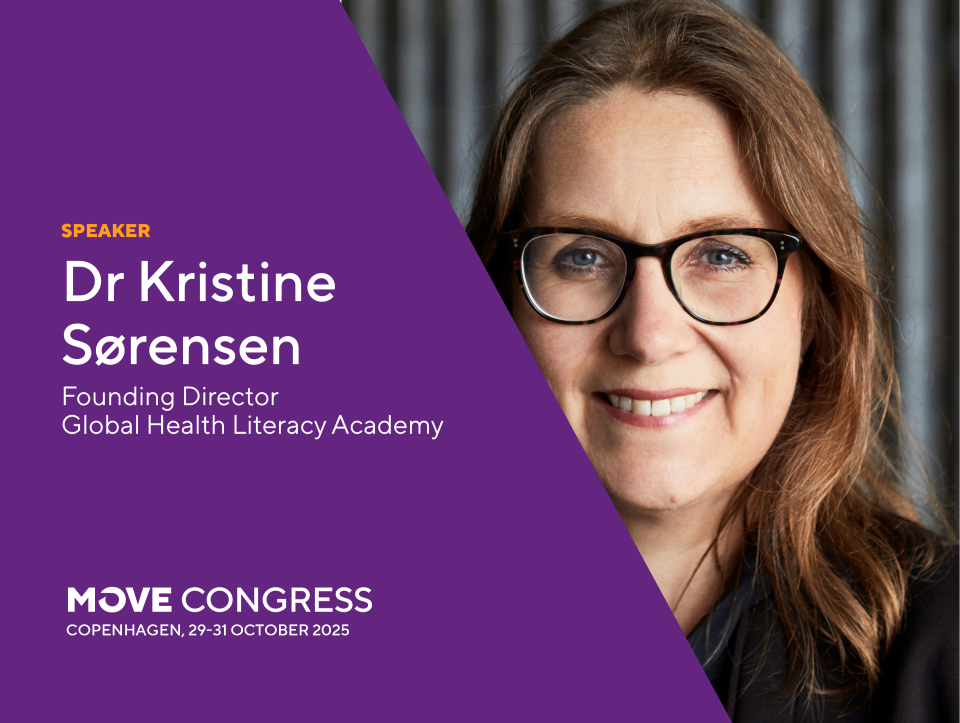
Dr Kristine Sørensen is an international health literacy expert and the founder of the Global Health Literacy Academy, an organisation that supports leaders in embedding health literacy into their organisations.
Ahead of her presentation at the 2025 MOVE Congress, she highlights the growing recognition that health literacy is not only vital for improving health outcomes – it is also a fundamental human right.
What are the most pressing challenges facing the promotion of health and physical literacy?
One in every two people face challenges related to finding, understanding, appraising and applying information on managing their own health and well-being. Health literacy is not just about knowledge. It’s about being able to act and being able to manage health conditions in the best way possible. Engaging in sport and physical activity also stimulates mental and social health. Hence, effective health literacy strategies can be highly empowering. Ultimately, they increase our ability to activate ourselves.
How has the global conversation around physical literacy shifted in recent years, and what progress or changes have you seen?
After the Covid-19 pandemic it became clear that health literacy plays an essential role in how successfully people are able to deal with health challenges. Several countries including Norway, Slovenia and Austria have now developed specific national health literacy action plans. It’s increasingly being recognized that a lack of health literacy is not only a problem for individuals – it is a societal challenge that needs to be addressed. Therefore, professionals, managers and trainers can help by acting as health literacy champions and role models for living healthier lives.
Could you give us a preview of your presentation at the MOVE Congress – what themes or findings will you be sharing?
I’ll be referring to a new Council of Europe report which highlights how health literacy is a human rights concern. The ability to access health information and to make informed choices has great impact on many different population groups in terms of equal access to healthcare as well as the settings and environments that support well-being. These can include Healthy Cities, Health-Promoting Schools, and the engagement of communities in sports and health-promoting leisure activities.
Integrating health literacy into organisations and society often requires shifting attitudes and behaviours. What are in your opinion the most effective ways to do this? Could health literacy be better-integrated into the school curriculum for example?
Currently, health and well-being issues are taught as add-ons to existing school curricula in many countries. My dream is to integrate health and physical literacy as a standard school subject in line with, for example, biology, maths and languages. We can do much to integrate it as a core topic and engage relevant professionals – including those present at the MOVE Congress – in the process.
 And finally, could you tell us your favourite way to be physically active—whether it’s a sport, dance, or everyday movement?
I love outdoor activities like hiking in nature and sea kayaking. There’s nothing better than watching the sky and the waves and spotting animals like seals and birds. It makes my day.
Dr Kristine Sørensen is working for the advancement and promotion of health literacy across the public and private sectors including civil society and academia. With a background in public health and global diplomacy, she has previously worked with the World Health Organization, the Council of Europe, national governments, McKinsey, and universities worldwide. In addition to serving on national and international advisory boards, she has published widely cited research and authored a number of influential books.
Register now for the MOVE Congress.

