
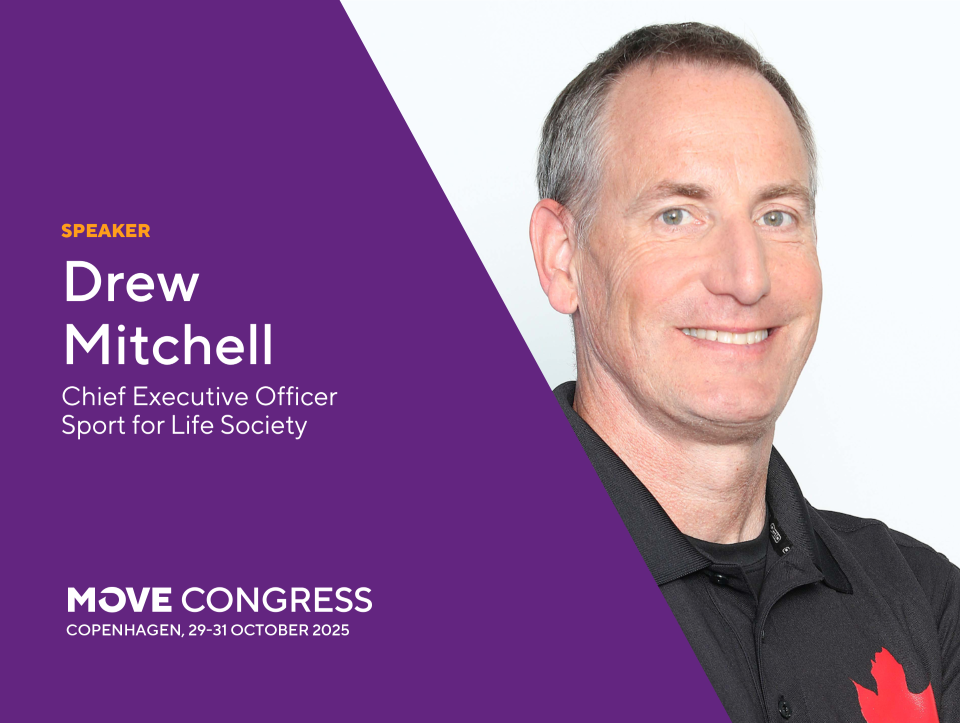
At the MOVE Congress on 31 October, physical literacy expert Drew Mitchell will explore how communities can move beyond fragmented approaches towards a more integrated vision of lifelong health.
What are the most pressing issues or challenges facing the promotion of community physical literacy?
Significant challenges include low public and decisionmaker awareness of what physical literacy actually means. We also see fragmented delivery across schools, sport, recreation and health sectors due to little or no collaboration and a lack of sustained funding that limits long-term impact. Access and equity barriers such as cost, transportation, cultural relevance and inclusive programming prevent many priority groups from participating. At the same time, rising sedentary behaviour and screen time reduce opportunities for children to develop movement skills naturally, while adults and older populations are often overlooked entirely.
Compounding this are shortages of trained leaders and insufficient evaluation tools to demonstrate outcomes and build the case for continued investment. Together, these issues make it difficult to create coordinated, equitable, and sustainable opportunities for people of all ages to build the skills, confidence, and motivation they need to be active for life.
Has the global conversation around physical literacy shifted in recent years? If so, what changes have you seen?
It has moved from being primarily a sport and education concept to a broader public health, community well-being, and lifelong engagement issue. More countries and organizations now frame physical literacy as a foundation for healthy living and mental well-being, not just youth sport participation. Furthermore, there is a growing emphasis on inclusion, equity, and cultural relevance — especially for indigenous populations, people with disabilities and newcomers.
The field has also seen progress in developing shared definitions, national strategies, and measurement tools such as assessment frameworks in Canada, the UK, and Australia, which have improved cross-sector collaboration between education, recreation, health, and municipal planning. Although disparities remain, a stronger focus now exists on sustainable funding, the training of frontline leaders, and embedding physical literacy into policy and built environments. This signals a gradual but meaningful move from pilot projects toward systemic change.
Could you give us a preview of your presentation at the MOVE Congress? What themes will you be sharing?
We’ve spent a number of years building community cross-sectoral partner tables focusing on developing physical literacy with the intention of increasing physical activity. We felt this was vital because it equips individuals with the fundamental movement skills, confidence, and motivation needed to be active throughout life, which directly supports physical and mental well-being.
When communities first invest in building these competencies equitably, they create an engaged, active population that is more receptive to broader health initiatives. With the more recent evolution of health literacy this naturally sets the stage for evolving into a more comprehensive approach, where people not only participate in healthy behaviours but also gain the knowledge, critical thinking, and self-management skills to make informed decisions about nutrition, mental health, chronic disease prevention, and use of health services. By progressing from physical literacy to health literacy, communities can move from simply increasing activity levels to fostering a culture of comprehensive, lifelong wellness.
 Could you tell us your favourite way of being physically active?
My favourite way to be physically active is to be outside in my community – Penticton in British Columbia, Canada. So many trails to ride, run or hike, two separate lakes, plus amazing winter sport conditions on our local mountain. As the President of our local triathlon club I do spend more time swimming, riding or running but expand that in the winter to include cross-country skiing and snow shoeing. Being so active enhances my mental state and allows me to be engaged with a wide variety of friends and family. A new addition to my life is my first grandchild, Margot, who is so bubbly and happy it is contagious!
Drew Mitchell has been involved in sport and physical activity for over fifty years as an athlete, coach, volunteer, developer and director. He is currently the Chief Executive Officer for the Canada-based Sport for Life Society and a leader in the development of community physical literacy. His former roles include Manager of Science & Medicine Programs for SportMedBC where he worked with over 50 different sports at the local, provincial and national level. He also managed Sport Technical and Performance Services for the ‘2010 Legacies Now’, a nonprofit that focused on creating lasting community benefits from the 2010 Vancouver Olympic and Paralympic Winter Games.
Register for the MOVE Congress here: https://movecongress.com/register

