
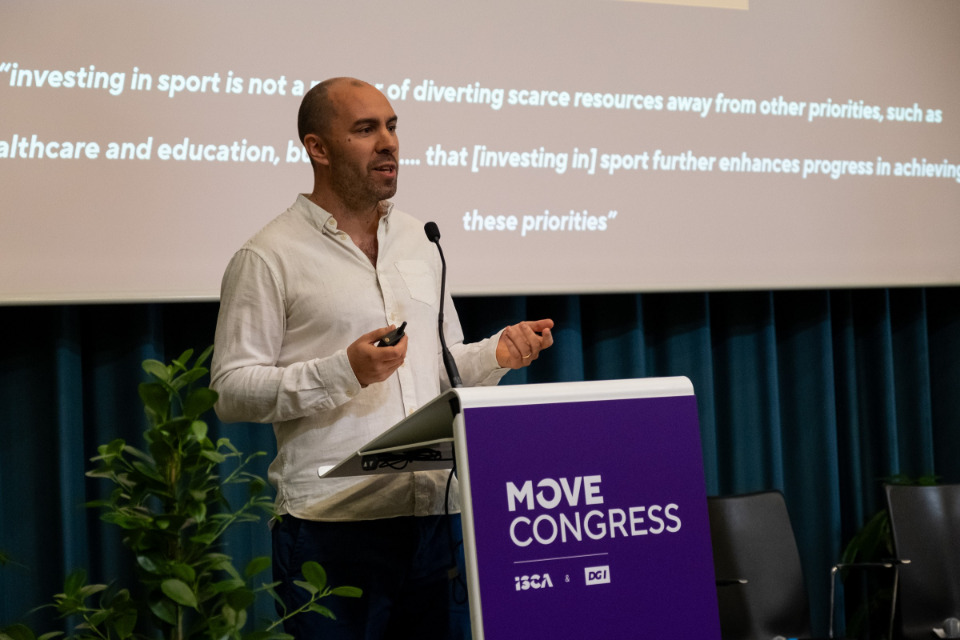
Despite compelling evidence of its many benefits, the grassroots sport and physical activity sector still struggles to secure adequate investment – and when savings are required, it is often the first target of cuts. On the final day of the MOVE Congress, funding experts asked how the sector can present a more convincing case for investment.
The physical, social and mental health benefits of physical activity are all proven, as are the significant long term savings to healthcare budgets. So why do policymakers often regard health-enhancing initiatives as “nice to have” rather than essential? The question was addressed by an expert panel comprising of Sam Johnson, Sustainable Transport Specialist at the World Bank; Caroline Brooks, Head of Physical Activity at the World Federation of the Sporting Goods Industry (WFSGI); Yvonne Henry, Director of Brands at Women Win; and Kiraz Öcal, Co-founder of Kızlar Sahada / Women on the Field.
The session’s moderator, ISCA Strategic Partnerships Officer Patrick Ashcroft, noted that only around 0.04 % of the total EU budget is currently allocated to sport, and just two percent of the Erasmus + budget. How, he asked, can the sector secure a larger slice of the pie? Is it through better communication, new financing initiatives, improved use of impact data—or all of the above?
Supporting active travel has proven to be a sound investment, Sam Johnson argued. Yet most governments still invest significantly less than one per cent of their road budgets in activities such as walking, jogging and cycling . “It’s a basic responsibility of road agencies to enable active travel,” he said. “Without meaningful budgets we are fighting with one hand tied behind our back.”
Basic responsibility
“Funders need clear cost‑benefit analyses,” he said. “Funding applications must be presented as investments that all politicians can support. For example, arguments for active travel can be tailored to suit funders. They might focus on improving environments for children, lower housing costs through reduced parking needs, or creating opportunities for economic growth and jobs.”
A typical analysis, he said, would compare the cost and maintenance of new facilities with the long term financial benefits derived from them – factors like improved public health, reduced traffic congestion and lower carbon emissions. In an average case, he said, every dollar invested returned about five dollars.
“Some authorities respond to a straightforward business case,” he added. “Funding active travel strengthens a city’s appeal to external investors. It may not be glamorous storytelling, but it is language that governments understand.”

In a changing world where many issues are interconnected, Yvonne Henry said, funding streams remain fragmented and top‑down. All too often, she said, funding is short term, project‑based, and characterised by time-consuming reporting requirements. “The decisions taken are often far from the reality on the ground,” she said. “The existing conditions around philanthropy — reporting, control and due-diligence — mean we have a lot to unlearn.”
The global NGO Women Win, she said, supports a pooled-funding mechanism which prioritises organisations rather than individual projects. The ONSIDE Fund brings together many funders under a single model, with decisions taken by grassroots leaders and due diligence adapted to be flexible and trusting. Unfortunately, only four percent of applications to ONSIDE are approved, she added – largely because of insufficient funds.
Monetary values
“What is the value of the MOVE Congress and how do we define it?” asked Kiraz Öcal. A variety of responses from the audience illustrated the different ways in which we perceive concrete results. “Too often sport is seen as a luxury rather than a fundamental need like housing and food” she said. “But we can reframe it as the vital link between health and education.”
Since 2016, she said, the Kızlar Sahada organisation has used the SROI (Social Return on Investment) method as a strong tool in discussions with potential funders. SROI converts outcomes — including non-financial ones — into monetary values wherever possible, meaning that the financial benefits of initiatives can be compared with the investment made. “SROI makes things tangible,” she said, “It helps to communicate information in a way that stakeholders can understand, using evidence people recognise.”
As governments and companies are legally obliged to achieve carbon emissions cuts, she said, the funding of projects can help them achieve their binding commitments. “Measurement matters,” Öcal said. “SROI provides independent, tangible and solid evidence that is not only useful for funders, but for all stakeholders.”
“This generation is the least–active in history, and unless we act, the situation will worsen” said the WFSGI’s Caroline Brooks. “We are here, ready to work with others,”
Her organisation represents around 70 percent of the global sporting goods industry’s turnover, she pointed out, and is committed to action on physical activity as a top priority. In June 2024, she said, the WFSGI issued a joint statement calling for urgent action on inactivity, and has also launched an impact report in collaboration with the WHO.
However, the companies represented by the WFSGI did not escape criticism: audience members pointed out that their investments in health and physical activity are negligible compared with the savings they achieve through intricate tax planning arrangements.
The session concluded with a discussion on whether the sector should still be talking about “telling better stories” at all, given that the argument for increased funding has already been won. According to some participants, the sector should concentrate its efforts on pressuring governments to allocate more resources to grassroots sport from tax revenues. Despite huge salaries, elitism and corruption, vast sums of public money continue to flow into elite professional sport. Given the inactivity crisis, participants asked, isn’t it time for a shift in priorities?

