
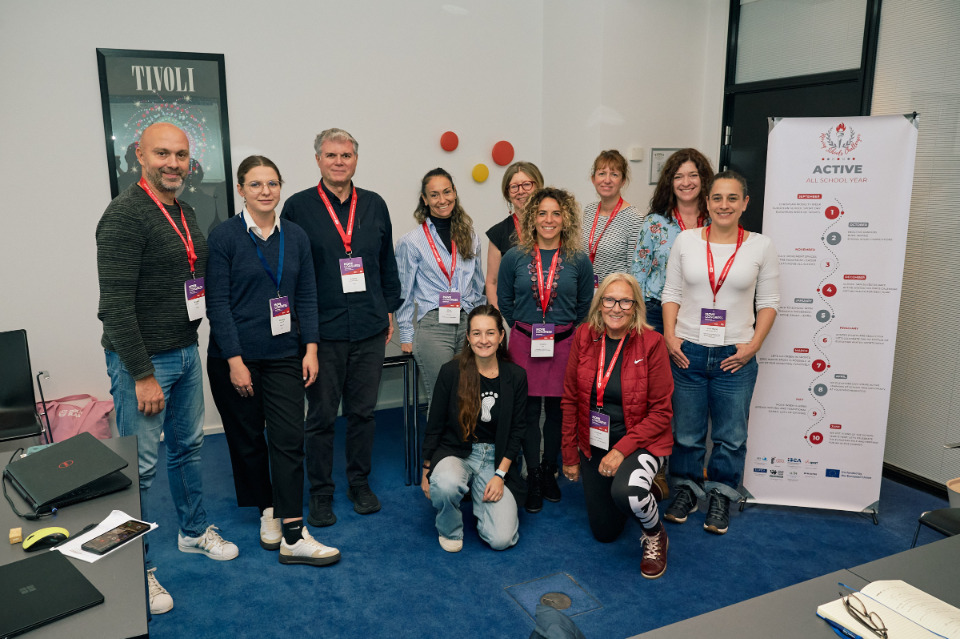
The Moving Schools Challenger (MSC) project has crossed the finish line in style. Its closing meeting brought together experts, researchers, and movement advocates from across Europe to celebrate three years of collaboration, creativity, and community impact. For the past three years, partners have worked to transform classrooms into spaces of movement and wellbeing – and the final event reflected exactly that spirit: vibrant, involved, and full of motion.
The closing meeting took place alongside the MOVE Congress, one of the most inspiring gatherings for physical activity and grassroots sport in the world. The MSC team made sure participants didn’t just talk about movement – they lived it.
Among the highlights was the “Speed Dating” activity, led by Viv Holt (YSTI), Vivi Zito (EUPEA) and Antonio Sánchaz Guitián (DES) which combined playful interaction with meaningful reflection. Participants moved between round tables to discuss three key questions:
Each of the three 20-minute rounds blended quick presentations, brainstorming with sticky notes, and even short bursts of physical activity inspired by Milano–Cortina Winter Olympic sports.
“We wanted people to feel the energy of the project – not just hear about it,” said Viv Holt, facilitator of the session. “It’s all about making movement part of learning and teamwork.”

(Photo: Vivinne Holt introducing the project on stage, in 30 seconds, to kickoff the speed dating session.)
Meanwhile, in the MOVE Congress lobby, the Juice Bike station became a crowd favourite. Attendees pedalled to blend smoothies, literally powering their own refreshments while learning about MSC’s Healthy Kilometres (HKm) – a fun, sustainable approach to integrating physical activity into everyday routines.
“The Juice Bike was a perfect metaphor,” noted Anita Király from the ISCA team. “It shows that when we move, we create energy – for our bodies, our schools, and our communities.”

(Photo: MOVE Congress mascot inviting participants to the Juice Bike.)
Reflecting on Achievements and Challenges
Beyond the fun and movement, the meeting also served as a serious platform for reflection on the three years of hard work. DES presented updates on project coordination and the submission of final deliverables. ISCA led discussions on communication impact. Over the past three years, partners have shared content across Europe, from social media campaigns to multiplier events, reaching hundreds of schools and thousands of students.
“Our biggest strength has been being genuine,” said Antonio Sánchez Guitián, from DES. “Each partner adapted MSC to their own national context, proving that movement-based learning works everywhere.”
Building a Sustainable Future
The most important message of the day was clear: MSC is not ending – it’s evolving.
DES presented the Sustainability Report, outlining plans to integrate MSC into partners’ ongoing operations. All partners confirmed their commitment to continuing MSC activities beyond the funding period.
At the University of Madrid (UAM), plans are already underway to include the MSC approach into teacher education, ensuring future educators are equipped to promote movement-based learning.
“MSC has proven that movement can transform learning,” said Professor Veronia Cabanas Sanchez from UAM. “Now we’re taking that knowledge into the classroom, training teachers to make every lesson an opportunity to move.”
The consortium also discussed launching a new edition of MSC inspired by the Olympic spirit – featuring a Winter Games edition (for the monthly challenges between October–February) and a Mediterranean Games edition (summer 2026). These versions will build on the project’s playful, competitive approach to motivate schools across Europe to stay active.
As the day drew to a close, partners gathered for a final round of reflections led by DES. The atmosphere was one of gratitude, excitement, and shared purpose. The Moving Schools Challenger may have reached the end of its formal project cycle, but its mission – to bring more movement, joy, and connection into schools – is just getting started.
“We’ve built a community that believes in movement as education,” said Viviana Zito (EUPEA), “And that movement will keep growing – in every classroom, playground, and city where MSC has left its mark.”
For more information about the Moving Schools Challenger and its next steps, visit www.movingschools.eu
Key facts
Project period: January 2023-December 2025
Co-funded by: Erasmus+ Sport Cooperation Partnerships
Grant amount: €400,000
Project partners:

