
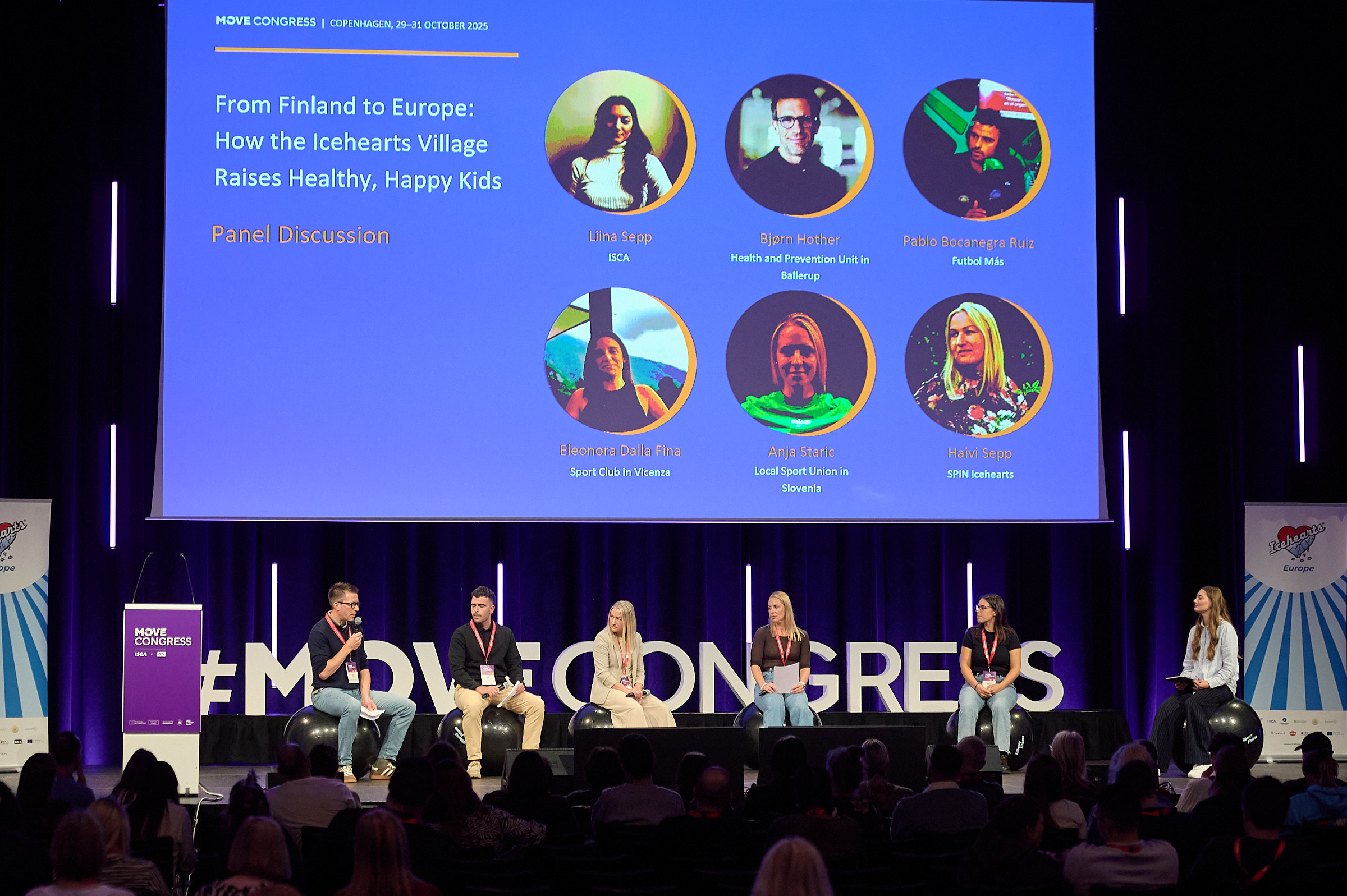
After nearly three years of practice, reflection and shared learning, the Icehearts Europe project’s partners arrived in Copenhagen ready to share what they had learned. Gathered alongside MOVE Congress 2025, over 850 participants had the opportunity to look back on a journey that began with a simple question — “How will we make this work?” — and developed into a community of experts, advocates and mentors prepared to show others how to build their own Icehearts “villages” to protect and support children.
“It takes a village to raise a happy, healthy child” – this African pro-verb was the thought that ran through the event and, in many ways, underpinned how the project worked: surrounding each child with continuous support from mentors and connected services.
Icehearts Europe adapts and scales the Finnish Icehearts mentoring model — long-term, sport-based support — for new European contexts to improve the mental health and wellbeing of disadvantaged children and young people.
Over the past three years, the programme has run pilot activities in Denmark, Estonia, Italy, Slovenia and Spain, offering relationship-based support to more than 2,200 children.
From Icehearts Child to Icehearts Leader
The closing event opened with a story that goes to the heart of Icehearts itself. Aleksandr Kanevski, now Chairperson of Icehearts Finland, stood on stage — not only as an organisational leader, but as someone who once wore the Icehearts jersey himself.
“Icehearts gave me a safe community to be myself,” Kanevski said, recalling how, as a young immigrant to Finland, he found belonging through sport and trust. “When I was a child, I didn’t have a community — I just had my name. Then I got a team.”
Founded in Finland in 1996, Icehearts is not simply a sports programme. Sport is the tool; the method is long-term mentoring. After preschool teachers and social workers identify children at risk of social exclusion (typically around age six), each child is supported by the same mentor for up to twelve years. The depth and continuity of that relationship help prevent school dropout and social difficulties.
Asked by the audience how mentors stay committed for so long, Kanevski smiled: “They have a team. Would you like to leave your team?”

Exploring the Heart of the Model
Dr Fiona Chambers (University College Cork) walked participants through the Icehearts Europe framework — now recognised by the OECD as an example of good practice in child-centred sport and education. She stressed that while each country adapted the Finnish approach to its own systems, the core aim stayed constant: to create safe places where children belong, play and grow.
“All children need to have fun, feel secure and make friends,” Chambers said. “And if we look at the statistics, 20% of adolescents experience mental health problems — prevention is not a luxury; it’s a necessity.”
Following her presentation, the discussion turned to the people behind the practice — those delivering Icehearts every day across Europe.

Key reflections from the partners
A panel of representatives from all partner countries reflected on what, for them, defines the true “heart” of Icehearts:
“Icehearts is a story of cooperation, education and sport — but above all, it’s a story of trust,” said Anja Starič from the Sports Union of Slovenia.
Across all speakers, the message was consistent: children thrive when support comes through strong relationships — mentors who listen, and communities that work together.
Learning Through Play: Lessons from the Journey
Project leaders from the five pilot countries spoke about their experiences — the challenges, the breakthroughs and the moments that made it all worthwhile.
“We started with a big question mark,” said Špela Voje (Slovenia). “How will we translate the Finnish model to our reality? But when you have a good cause, things start falling into place.”
Irma Preka (Italy) added, “This project changed children’s lives — and mine too. I’ve seen so much growth, so much joy.”
From Denmark, Charlotte Dalsgaard relayed a mentor’s on-court reflection: “I don’t see vulnerable children here. I see happy children — courageous, equal and ready to play.”
Trust and teamwork were also central to a peer-learning workshop led by the UCC team using LEGO® SERIOUS PLAY®. Participants were invited to “build their village” — a symbolic landscape of the elements that make Icehearts strong.

Beyond the Sessions
Alongside the main programme, delegates joined a study visit, took part in a speed-dating project session, and — for project partners — a final meeting to take stock and plan for the future.
During the visit to Ballerup Municipality, participants saw how Icehearts Europe principles are embedded in local community programmes. Supported by DGI and the municipal Prevention Unit, the Danish approach places activities directly in social housing areas, removing transport and cost barriers for families.
“In prevention, you start early — from the moment they learn to walk,” explained Eva Sønderberg Larsen from the municipal Prevention Unit, emphasizing the importance of early action in building healthier, more connected communities. They also highlighted the municipality’s role in ensuring activities are free and easily accessible for families who may not have the means to drive their children to sports or leisure sessions.
Kristine Helverskov Nielsen, a mentor, summed up the spirit on the ground: “Some families may have limited financial resources, but they have love, determination and strength.”

Continuing the Journey
As partners wrapped up their final project meeting, they looked ahead. Icehearts Europe’s funded phase may be ending, but its impact carries on — in the children who found their teams, in the mentors who stood by them, and in the communities now confident about building their own villages. In Ballerup, the programme will continue for at least three more years with municipal support. Elsewhere, the lessons gained will hopefully pave the way for future initiatives.

Funded by the European Union. Views and opinions expressed are however those of the author(s) only and do not necessarily reflect those of the European Union or the European Health and Digital Executive Agency (HADEA). Neither the European Union nor HADEA can be held responsible for them.

