
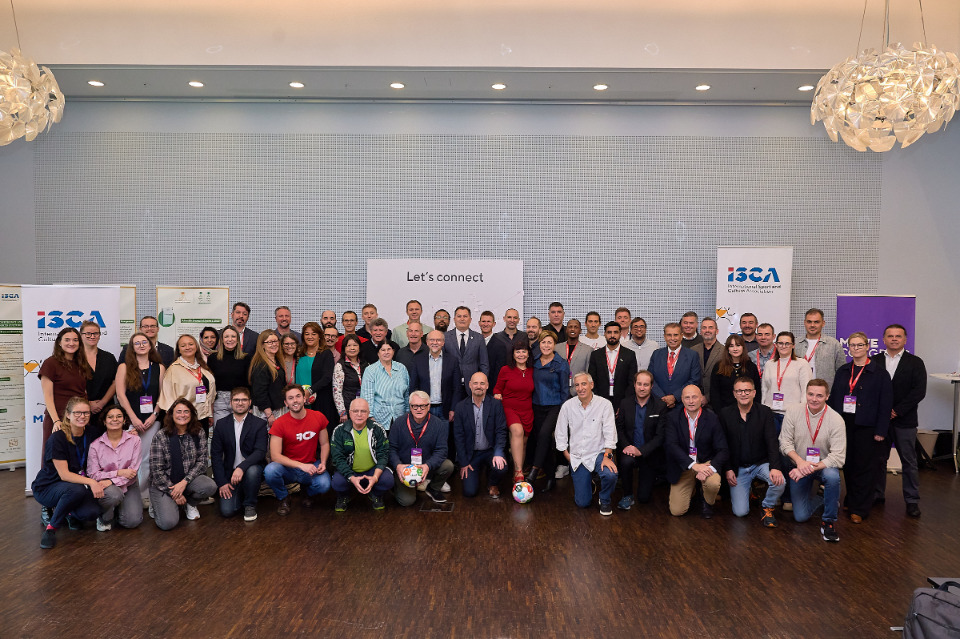
The International Sport and Culture Association (ISCA) gathered its members and partners for the 2025 General Assembly in Copenhagen, alongside the MOVE Congress, to shape the future direction of global grassroots sport. The Assembly adopted the ISCA Strategy 2026–2029, 23 new members, and elected a renewed Executive Committee, both signalling a confident and visionary path for the next four years.
ISCA Strategy 2026–2029: Moving the World – Together
ISCA has launched its new Strategy for 2026–2029, and it’s all about one powerful idea: everyone, everywhere, should be able to enjoy the Human Right to MOVE. Over the next four years, ISCA will bring this vision to life by empowering changemakers, connecting communities, and driving global action through grassroots sport and physical activity.
The ISCA Strategy 2026–2029, adopted unanimously by delegates, sets a bold course for strengthening ISCA’s impact across four key pillars: thematic projects, NowWeMove campaigns, advocacy, and the MOVE Congress. The strategy builds upon ISCA’s mission to promote the individual and societal value of sport, physical activity, and play—prioritising meaning over medals and values over money – emphasised by Mogens Kirkeby, President of ISCA, in his presentation. For ISCA, movement isn’t just exercise — it’s a way to connect people, strengthen societies, and build healthier, happier lives. The new strategy outlines how ISCA will expand its global impact, leveraging its strong European foundation to establish a truly global network that advocates for inclusion, wellbeing, and education through movement.

In presenting the strategy, President Mogens Kirkeby highlighted its focus on empowering citizen-led initiatives and scaling the impact of ISCA’s global network. “We will continue to be the voice of the citizen-driven sport sector,” said Mogens Kirkeby. “Our strategy is not about competition—it is about connection, cooperation, and creating lasting change for people and communities.”
“We believe that every person has the Human Right to MOVE,” the strategy declares — a message that captures ISCA’s belief in the universal power of physical activity. This is not just a slogan but a statement of purpose: movement should be accessible, inclusive, and recognised as essential for both individuals and communities.
At its heart, the strategy is about people. ISCA will focus on growing and supporting its global community, building stronger connections between member organisations, local leaders, and changemakers who share the passion for getting more people active. The plan also commits to expanding ISCA’s role as a knowledge hub and catalyst, providing the tools, skills, and opportunities that help grassroots initiatives thrive. And as ISCA’s influence grows, it also aims to become a resource mobiliser and grant-maker, ensuring that the organisations making a difference have the support they need to keep going. To make all of this happen, ISCA is drawing on what it does best — bringing people together. Its convening power will continue to drive collaboration across borders and sectors, while digital development will help connect communities and share resources on a global scale. From face-to-face meetings to online learning and campaigns, ISCA’s approach blends personal connection with innovation.
The theory of change behind this strategy is simple but powerful: when we support the people who create opportunities for movement, we create a ripple effect that transforms entire societies. By working with its members and partners, ISCA aims to influence policy, inspire media attention, and mobilise private and public sectors around the value of sport and physical activity. Progress will be measured through ISCA’s Monitoring, Evaluation and Learning (MEL) framework, which tracks engagement, satisfaction, and growth across its network. The ultimate goal is ambitious but clear — to contribute to the global effort to reduce physical inactivity by 15 percent by 2030, in line with WHO targets.
To turn this vision into reality, ISCA will build its work on four pillars. The MOVE Congress, its flagship gathering, will continue to be the beating heart of the community – a space for learning, inspiration, trust-building and collaboration. Held every two years, it will evolve through regional events and innovative formats that make participation easier and more sustainable.
Through thematic projects, ISCA will continue to lead and partner in international collaborations that connect sport to broader social goals, including education, inclusion, sustainability, and wellbeing. These projects will create practical resources and enable international transfer of knowledge.
ISCA’s advocacy efforts will continue to raise the voice of grassroots sport on the global stage. By producing evidence, building coalitions, and supporting local advocacy, ISCA will show why investing in physical activity pays off — for people, economies, and societies.
And finally, the NowWeMOVE campaign will remain ISCA’s global invitation to get active. Events like MOVE Week, No Elevators Day, and European School Sports Day have already inspired millions. Between 2026 and 2029, these will expand even further – with a stronger digital presence, new local initiatives, and a landmark milestone: MOVE Week Africa, launching in 2026.
The ISCA Strategy 2026–2029 is more than a plan — it’s a movement. It’s a call to communities, organisations, and individuals to come together, take action, and make movement part of everyday life. With a blend of innovation, collaboration, and heart, ISCA’s next chapter is about one simple but powerful goal: to keep the world #MovingPeople. It also reinforces ISCA’s leadership role in international cooperation, supporting members to engage in EU and global initiatives, including NowWeMOVE and Integration of Refugees Through Sport (IRTS).
New Executive Committee Elected to Lead ISCA’s Next Chapter
Delegates elected a new Executive Committee (ExCo) for 2025–2027, assigning a diverse and experienced team to guide ISCA’s implementation of the new strategy.
President:
Vice Presidents:
Executive Committee Members:
The results reflect ISCA’s commitment to global diversity and cross-sector cooperation. President Kirkeby thanked outgoing members Maria Luisa Souza Dias, Fernando Alves da Silva, and Patrice Roder for their service, and welcomed the new team that “will take ISCA’s mission to the next level.” “With this Executive Committee, ISCA stands stronger than ever,” he noted. “Together, we will ensure that the voices of citizens, communities, and civil-society organisations are heard at every level of sport and physical activity policy.”

(Photo credit: V4Sport, Jakub Kalinowski)
Strong Growth and Global Reach
The Assembly celebrated ISCA’s continued expansion, with 23 new member organisations from across Europe, Africa, Asia, and the Americas formally adopted. The association connects more than 100 full and premium member organisations worldwide, and engages a community of almost 16.000 grassroots sport and physical activity promoters.
Secretary General Jacob Schouenborg presented the ISCA Impact Report, highlighting the association’s leadership in a total of 137 international projects, 52 of which were led by ISCA, as well as its strong advocacy initiatives, including the recent Active Children Coalition launch and the MOVE Congress 2025.
Financially, the assembly took note of the recent accounts, and approved the 2025–2027 budget, the continuation of Buus Jensen as auditor, and unchanged membership fees.
Building Bridges Through Global Partnerships
A highlight of the meeting was a presentation by Dr. Ben Sanders, Executive Director of Sportanddev.org, who reflected on ISCA’s role as host of the platform since 2023. He emphasised the growing importance of sport in achieving the Sustainable Development Goals (SDGs) and thanked ISCA for its support in strengthening the global Sport for Development and Peace (SDP) sector. “If you want to go fast, go alone. If you want to go far, go together,” Dr. Sanders said, underscoring the shared vision of collaboration between sportanddev and ISCA.

Looking Ahead
The General Assembly concluded with closing remarks from President Kirkeby, who thanked all delegates, the Chairs Elena Garcia Morales and Patrik Peroša, and the ISCA team for their dedicated work. He called on members to remain engaged and forward-looking as the organisation enters its new strategic period. “ISCA’s strength lies in its openness and its people,” Kirkeby said. “Let us continue to work together—across borders and sectors—to activate citizens and communities around the world.”
The session closed with applause, group photos, and announcements of upcoming initiatives, including the Viborg Academy for Sport and the International Physical Literacy Conference 2026 in Toulouse.
Read the full Delegate File with all candidates, strategies and documents: https://www.isca.org/delegate-file-2025

