
Sport is often called a universal language. In Copenhagen, that idea took on urgent meaning as the Global IRTS Forum convened at MOVE Congress 2025, drawing close to 900 participants from across the world.
The Forum formed part of Global IRTS—a two-year project co-funded by the European Union and anchored in ISCA’s first international knowledge hub and networking platform for the integration of refugees through sport. Alongside the Forum, Global IRTS project partners held their final meeting, where they exchanged lessons learned and reported on pilot work in Poland, Ukraine, Colombia, the USA and Denmark.
Framing the moment

Opening the Forum, Chiara Ghisi, Sport Project Coordinator at UNHCR, set the context with striking numbers: 123.2 million persons are forcibly displaced worldwide—one in 67 people on the planet. She explained why sport belongs in the most difficult settings: it brings joy into daily worries, creates routine and a sense of belonging, and speaks across languages. Her message was clear: “It is way more than a game. Sport is protection.”
That idea—sport as both shield and bridge—run through the day’s three sessions and the discussions around them.
Realities and opportunities
The Realities and Opportunities session explored how sport can help refugees rebuild confidence, regain purpose and connect with their new surroundings, while also strengthening the social fabric of host communities. A recorded contribution from Noorzai Ibrahimi (Programme Manager, Skateistan) captured the heart of this message: “Sport is a tool for learning and building confidence in children—children who might never have dared to dream about the future.”
From an organisational perspective, Gerald Mballe (Unified with Refugee Coordination, Special Olympics) highlighted that meaningful integration demands shared responsibility: “We have to go beyond normal participation towards partnership and responsibility, because this brings empowerment. For refugees, being part of the board gives stronger impact, gives power and makes what we do more sustainable.”
With many valuable insights and personal stories shared, the discussion showcased practical examples of how sport can create belonging and opportunity, even in the most challenging circumstances. Astère Tuyikorere (Director, Rwema Foundation Football Academy) closed the discussion with a powerful reflection: “May our stories be the echo of millions of stories out there; may they stand as the voices of families and friends on the move right now. Their voice matters and the world must listen.”

Safeguarding as standard
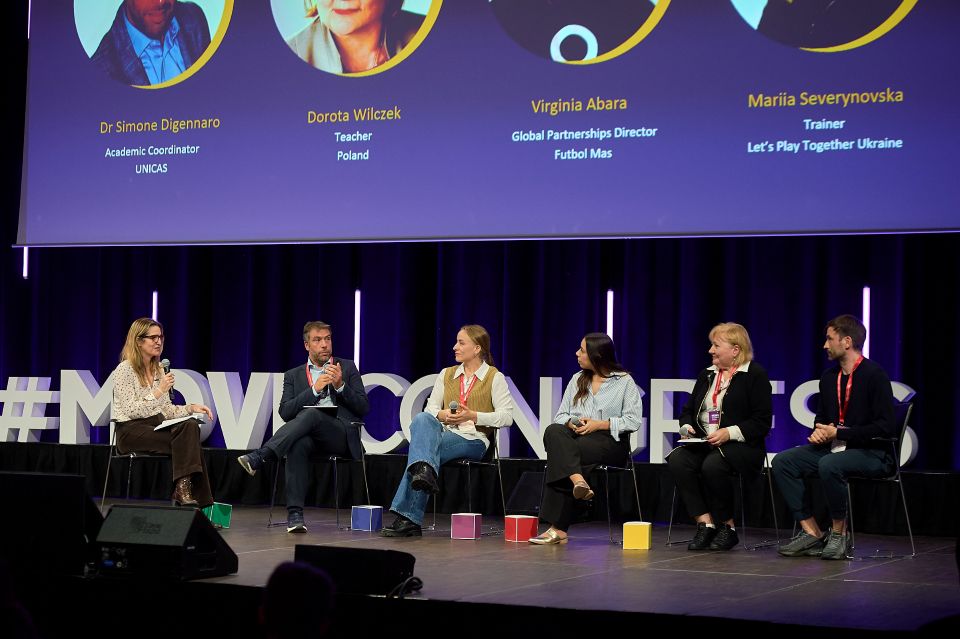
Safeguarding Sport: Protecting and Empowering Refugee Children shifted the focus to those most at risk. The message was unambiguous: safeguarding must be designed into programmes from the start—especially when working with children whose sense of safety has been disrupted.
Practitioners shared concrete ways to do this. Mariia Severynovska (Tandem Coach with the Let’s Play Together initiative, Poland), Dorota Wilczek (Primary School teacher, Poland), and Dr Simone Digennaro (University of Cassino and Southern Lazio, Italy) outlined child-centred coaching, culturally sensitive communication with parents, training for coaches and teachers, and inclusive spaces where multilingual children feel welcome. Virginia Abara (Fútbol Más, Spain) summed up the systems approach: “If we want to transform children’s lives in any way, we must go beyond the field – we need to work with the whole system around them.”
This session unfolded as a practical panel discussion, with practitioners comparing methods, sharing lessons from classrooms, clubs and community centres, and offering ready-to-use steps to make sport a protective and empowering part of children’s everyday lives.

Building communities
The closing discussion, Building Communities through Integration of Refugees through Sport, moderated by Adnan Abdul Ghani (Save the Children), asked a simple question: what makes community-level efforts stick? The panel’s answers were clear—shared ownership, strong local partnerships and real leadership pathways.
Dr Julian Rössler (Adidas Foundation) underlined the core principle: “We don’t see beneficiaries as passive recipients, but as active participants.” Percy Tussamba (pt² FITNESS) spoke about finding belonging through boxing: “People aren’t asking for respect; they’re asking for dignified treatment.”
Examples from Katinka Ernstsson (Save the Children) and Sima Kamal (Girl Power) pointed to practical next steps: integration must happen where most residents already live, learn and play—local clubs, community halls and schools. Both host communities and newcomers need opportunities to meet, train and lead together. Joe Smith (Centre for Healing and Justice through Sport) reinforced this message: “Communities should provide their own solutions — our role is to support that capacity.” The call to action? Move beyond charity towards shared ownership and co-creation, with refugees coaching, mentoring and shaping programmes from within.

IRTS in the spotlight
This year, the field of Integration of Refugees through Sport (IRTS) also gained significant attention at the MOVE Congress, with the ISCA Awards dedicated entirely to recognising achievements in this area. The Global IRTS Awards celebrated outstanding initiatives and leaders who support refugees and forcibly displaced persons through sport and physical activity.
The awards honoured four winners:
The ceremony highlighted how local action—whether a running group, a girls’ leadership programme or a refugee-led club—can inspire change far beyond the sports field, turning participation into empowerment and connection.
Read more: https://bit.ly/4hVHXYq
What Copenhagen showed
Across the Forum, one message stood out: integration works best when sport is treated as both protection and participation—a safe, structured, joyful space that restores routine, builds relationships and invites leadership. The Global IRTS project has shown how that can be organised—through proven methods, cross-sector partnerships and a network that helps practitioners learn from one another.
As the two-year project concludes and the partners’ final meeting wraps up, the work clearly continues. The pilots across Poland, Ukraine, Colombia, the USA and Denmark have demonstrated models that can be adapted elsewhere. In short: when communities open their clubs and halls, when safeguarding and co-design are standard, and when refugees lead from within, sport becomes a shared language of dignity, recovery and belonging.

Funded by the European Union. Views and opinions expressed are however those of the author(s) only and do not necessarily reflect those of the European Union or the European Education and Culture Executive Agency (EACEA). Neither the European Union nor EACEA can be held responsible for them.

