
Low physical activity levels and widening health inequalities remain two of our most stubborn, ongoing challenges. But what if we’ve been missing the “secret sauce”?
At the MOVE Congress 2025, the MOVING for Health track didn’t just host a discussion; it opened a kitchen. The goal: to stop treating physical literacy (PL) and health literacy (HL) as separate ingredients and start blending them into a recipe for real-world change.
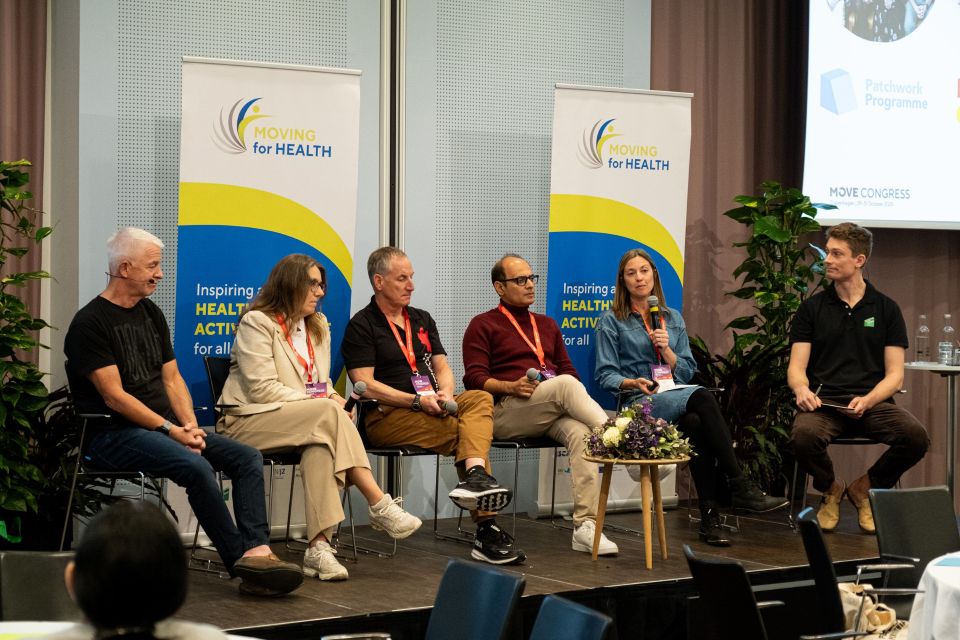
The two-part session, “Understanding Health & Physical Literacy: an Experiential Approach to the Secret Sauce” and “Become a Masterchef: Bridging Health and Physical Literacy in Your Context” brought together global experts to explore, co-create , and master the “how” of this powerful combination.
Why We Need a New Recipe
The first session, moderated by Grim Jernudd of Change the Game, Sweden, was not a typical lecture. It was an experience. Participants were immediately asked to create paper balls for “paperwork”- a playful juggling and throwing activity. The room filled with laughter as paper balls hit the floor. The point was clear: the activity instantly created connections: to others, to ourselves, and to the object – and sparked joy, all without the fear of failure.

This set the stage for the first session’s expert panel, which tackled a simple truth: our old methods aren’t enough. Charlie Crane, Head of Children and Young People Policy at Sport England, explained that physical literacy isn’t just about movement; it’s about our relationship with it.
“We now define physical literacy as our relationship with movement, and like any relationship, it is deeply personal, unique and ever changing.” — Charlie Crane, Sport England
This relationship is built on more than just physical competence; it includes enjoyment, confidence, and motivation. At the same time, Dr. Kristine Sørensen of the Global Health Literacy Academy redefined health literacy. It’s not just about understanding health information; it’s about the “ability to act”. It’s the skill to “access, understand, appraise, and apply information” to make sound health decisions in everyday life.
The key takeaway? These two concepts are incomplete without each other. Both are about equipping individuals with the skills, knowledge, and valuation for and motivation to live a healthy life.
From Theory to a Tangible Plan
Session 2, “Become a Masterchef” challenged participants to turn this insight into action. The expert panel shared stunning examples of implementation. Dr. Amit Malik of the International Physical Literacy Association (IPLA) shared a powerful story from India, where advocacy led one Chief Minister to a radical conclusion:
“I was always focused on results through medals. But now I learned something new… We need to build more playgrounds. But not build new playgrounds, break hospital and make them.” — Dr. Amit Malik, IPLA (quoting an Indian Chief Minister)
This quote captured the session’s core message: a radical shift from treatment to prevention.
Dr. Dean Kriellaars, a neuroscientist of the Research Centre for Human Potential in Montreal, guided participants through a hands-on workshop. He stressed that we must stop blaming individuals for their health choices when the systems around them fail to provide support. True change, he argued, requires building a supportive environment of “trained people, quality places, and programmes”.

The session then turned to pure teamwork and collaboration, moderated by Dr. Dean Kriellaars. This hands-on workshop had participants at their tables “rolling up the sleeves” to make action. They worked together to identify what individuals truly need to be equipped for health decisions and what community resources – people, places, and programmes are necessary to support them. The energy was focused as groups moved from ideas to identifying concrete actions they could start “tomorrow”.
The Secret Ingredient: We Are All Health Ambassadors
If there was one “secret ingredient” revealed at the Congress, it’s that this work cannot be done in silos. It requires a multi-sector “team effort”. As Drew Mitchell of Sport for Life Society noted, the solutions often already exist in our communities; they just need leadership to connect them.
Dr. Kriellaars hammered this point home, stating that this responsibility is too big for any one sector.
“You can’t just place health literacy and physical literacy on the backs of physical education and health education… Everybody has a role in it.” — Dr. Dean Kriellaars, Human Potential Research Centre
Dr. Kristine Sørensen urged everyone in the room, whether from grassroots sport, education, or policy, to see themselves as “health and well-being ambassadors”.
Your Journey Starts Now
The track closed with a clear call to action: take this recipe home, start these conversations, and implement these ideas in your own context.
But in a world obsessed with data, how do we measure the success of this new, blended approach? Dr. Sørensen provided the perfect answer, sharing a story of a dance teacher working with Parkinson’s patients. When asked how she measured success, the teacher replied:
“On the size of their smiles.”
This represents a powerful shift in thinking. Our take is that we must move beyond just counting minutes of activity and focus instead on our attempts to create positive, joyful, and healthy relationships with movement that last a lifetime.

