
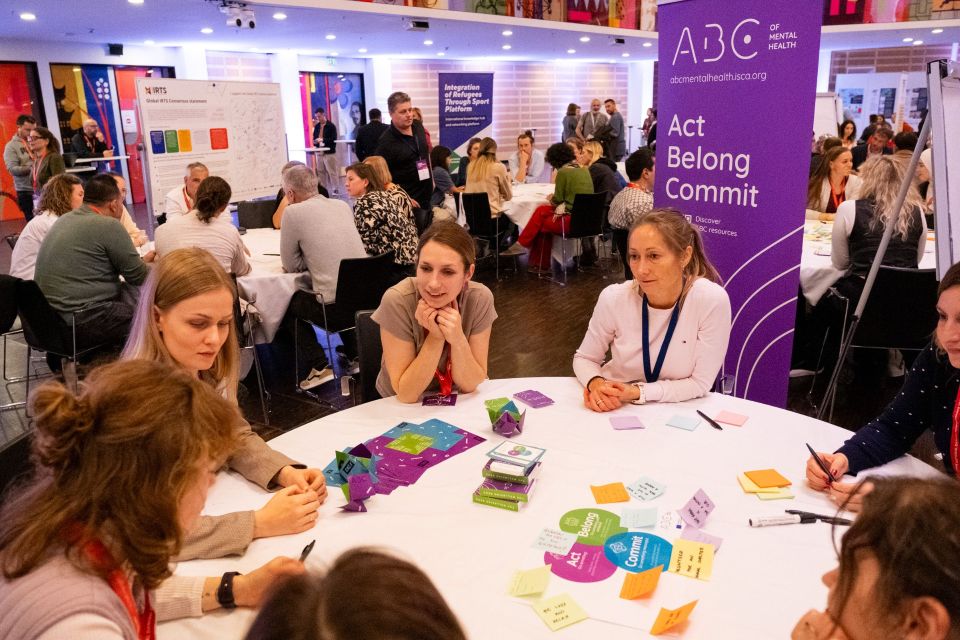
On the final day of the MOVE Congress, a major dissemination session was held showcasing one of ISCA’s flagship initiatives — the ABCs of Mental Health Europe. Featuring both global and grassroots voices, the session explored the many ways in which physical activity and meaningful contact can enhance mental well-being.
Plenty of evidence confirms that good mental health goes hand in hand with regular physical activity. However, translating this knowledge into best practice remains a major challenge. Developed by Curtin University in Western Australia, the Act Belong Commit (ABCs) campaign has successfully developed implementation methods centring on three key verbs: Act – do something active; Belong – do something with others; and Commit – do something meaningful.
At its core lies the task of enabling people to discover which activities give life meaning and value. These might be as simple as reading a book, joining a food club or taking a walk — in fact, virtually any action that promotes well-being is encouraged. In essence, the initiative offers motivational tools and best-practice solutions to strengthen well-being through many types of increased activity and community participation. Following proven success in Australia, the ISCA-led ABCs Europe project is now adapting and scaling the model across the continent through pilot programmes in Denmark, Italy, Poland, Sweden and Ukraine.
Dr Christina Pollard, Professor of Public Health Priorities at Curtin University and a key leader of the ABCs campaign, joined an expert panel that was asked to identify “base camps and summits” from a mental-health perspective. “The base camp would be a shared vision of where we want to go” she said. “Identifying the team, considering the obstacles that may be encountered, then travelling together to create greater impact, and make best-use of our skills.” The summit, she said, could be defined as a society that values mental health and where everyone has the opportunity to experience good mental health.
Identify barriers
“To effectively advocate for mental-health promotion we need to identify the barriers and concentrate on how to create an environment that can make a difference,” she said. “We need to focus on equality and advocacy, consider whom we are advocating for and what our key messages are, which can differ across countries and contexts.”
While most people have a degree of physical-health literacy, Pollard added, there is much to learn about maintaining and retaining good mental health. “There are many things we can do. We can ask ourselves, ‘have I done something today to improve my mental health?’ This can be as simple as helping someone else.”

Professor Felipe Barreto Schuch of Brazil’s Universidade Federal de Santa Maria defined his ‘base camp’ as a comprehensive assessment and the identification of potential barriers and challenges — which may vary in different contexts, for example poverty or lack of facilities. The second step, he said, is to determine the best way to overcome these barriers and identify the correct trail. “The main message is that everyone has their own way, their own trail,” he said.
“Lots of evidence exists on the impact of movement on mental health,” he said. “The short message is that any movement is better than none. Some movement is better than none. Extreme movement is not necessarily better for mental health than some movement.”
“Do what is achievable,” he said. “Some movement on a regular basis is best. The most important thing is that you enjoy it — find some exercise or movement that you can do in the long term.”
Do what is achievable
Sara Salmi, Project Manager at Italy’s SOS Children’s Villages, pointed out that ‘task shifting’ – training non‑specialists to deliver mental health support interventions – can make a real impact. Involving caregivers and other adults in areas such as stress management or problem solving can easily be taught, she noted, which extends the capacity of specialists. “This can be beneficial for both participants and volunteers,” she said. “Connection is one of the most important factors in mental health promotion.”
“We need to think about how we connect and how we link connection and inclusion with physical activity,” she said. “The ABC model fits very well with the promotion of community based interventions. Adaptability and context are key when you are planning your action. The trail is action and each trail is different; the summit is a psychologically informed community.”
Sharyn Burns, Professor of Health Promotion at Curtin University and another key leader in the ABCs campaign, pointed out that mental health issues are increasing and physical activity is decreasing globally. “The ABCs method has 15 protective factors with lots of research around them and one is, of course, physical activity,” she said. “Another is getting out into nature, and another is connecting with friends. People who talk outside their home have much better mental health than those who do not.”
She pointed out the importance of “doing something challenging” — which need not involve too much physical activity; some may run a marathon, others take a walk in the park or try their hand at gardening. “For some, it’s not that easy,” she said. “Factors such as disability, socio‑economic barriers, overwork or other challenges come into play. We must think about the best ways to integrate physical activity for these people too.”
Much of the advice that is offered is already common knowledge, the panel acknowledged. However, such knowledge can easily be forgotten or reduced in priority when it comes to budgets and the allocation of resources. The panel stressed that good mental health isn’t just about fixing what’s broken—it’s about maintaining well-being through resilience, connections, and movement.
In addition to the main dissemination event, the ABCs of Mental Health consortium held a dedicated project meeting which saw pilot projects presented and leaders share latest updates. The meeting, which saw Curtin University representatives providing valuable insights into adapting the ABC approach, concluded with a Next Adopters workshop which aimed to bring together potential future partners. The ABCs project was also showcased during a “Project Speed Dating” session, which helped to spark new connections and strengthen engagement across the network.

