
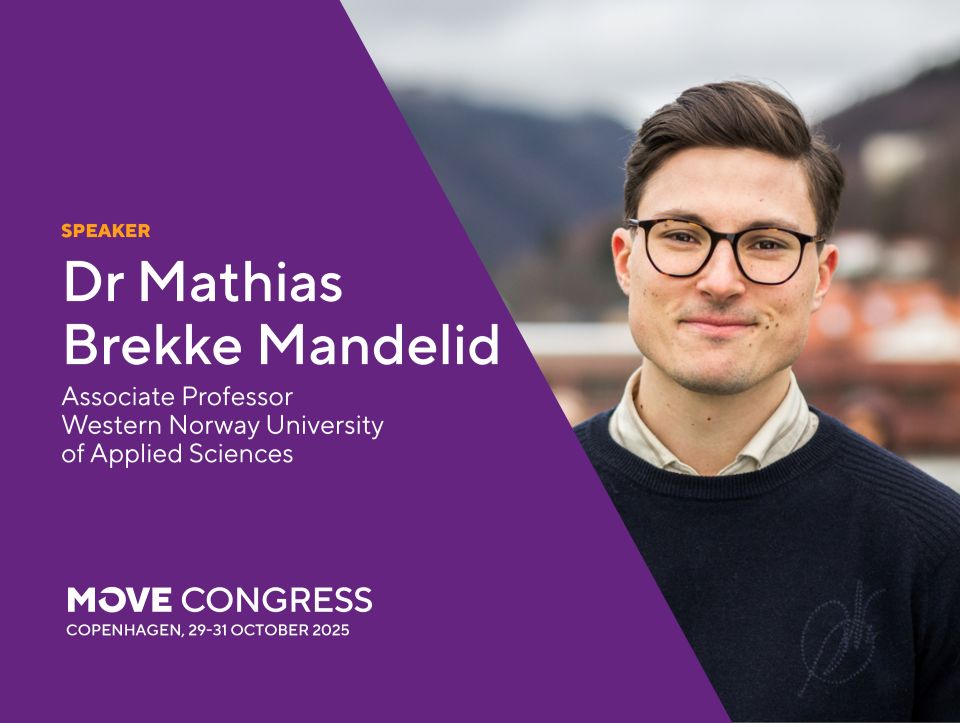
Dr Mathias Brekke Mandelid is a leading researcher in Physically Active Learning (PAL), which utilises movement in educational activities to support pupils’ growth. Ahead of his October 31 keynote MOVE Congress address, he outlines the important benefits that activity can offer to pupil education, such as improved academic performance, motivation and social integration.
What are the benefits of Physically Active Learning?
Research has consistently shown that integrating movement into academic activities can enhance pupils’ cognitive engagement, attention, and memory. PAL can increase pupils’ motivation by creating more engaging encounters with the subject. When pupils are physically engaged, they are more likely to stay focused, process information, and retain knowledge. This is particularly relevant in today’s classrooms, where maintaining concentration can be a challenge. When movement is used purposefully, it supports not only academic performance but also emotional and social development. That is, pupils’ holistic development.
What are the most pressing challenges facing PAL’s adoption in academic settings?
One major challenge is translating research into sustainable classroom practice. PAL has often been driven by health discourses, focusing on increasing physical activity minutes, which for teachers can be perceived as an external add-on or counterproductive to the learning process. Although the focus on physical activity minutes is important, this may have limited its uptake in schools. The integration of PAL needs to align with teachers’ pedagogical goals and classroom realities. There’s also a global political belief that learning is a sedentary activity. PAL challenges this notion.
What themes or findings will you share at the MOVE Congress?
I’ll explore the evolving landscape of PAL and its potential to shape the future of education. Drawing on recent research and conceptual developments, I will critically examine PAL’s potential as an innovative pedagogical approach that enables pupils to engage with the subject content through movement.
The presentation will also highlight how PAL can enhance pupils’ cognition and academic performance, and equally important, influence broader educational outcomes such as agency, identity formation and social cohesion. I will invite educators, researchers and policymakers to rethink how we design children’s entire education, and offer a vision of a more inclusive and dynamic future of schooling.
 What is your favourite way to be physically active?
My most common day-to-day activities are road biking, jogging, and strength training. However, I especially enjoy hiking in the Norwegian mountains both in summer and winter. It’s a way to disconnect, reflect, and reconnect with nature. Hiking often inspires new ideas and perspectives, both personally and professionally.
Dr Mathias Brekke Mandelid is an Associate Professor of Pedagogy at the Western Norway University of Applied Sciences. He previously led the Centre for Physically Active Learning (SEFAL), a research and education initiative established in 2018 at the university’s Sogndal campus (HVL). Additionally, he played a key role in implementing the Erasmus+ ACTivate project, a multi-country collaboration aimed at creating a European-wide PAL teacher training curriculum. His research focuses on pedagogy and didactics, particularly within the context of national and international educational policy.
Register for the MOVE Congress 2025 today: https://movecongress.com/register

