
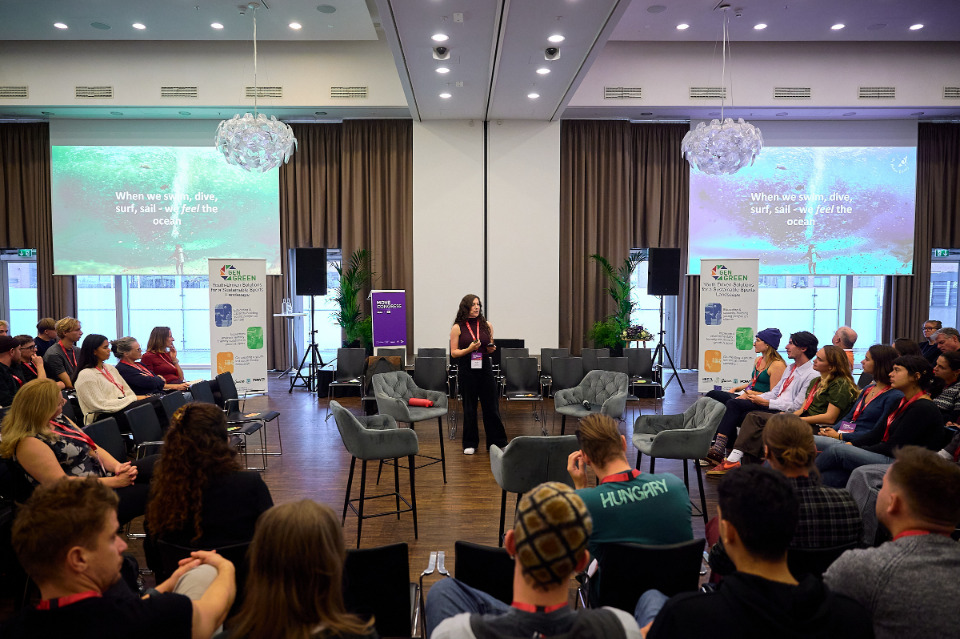
Climate discussions are often dominated by graphs, alarming statistics, and specialised language. ‘This Is Not the Usual Climate Talk’, however, set out to break that pattern. Instead of policy-heavy presentations, technical lectures, this session at the MOVE Congress in Copenhagen invited participants into a shared space shaped by connection, physical movement, storytelling, and intergenerational dialogue. What emerged was a new model for climate leadership – one that felt emotional, grounded in lived experience, and boldly honest.
Starting with the personal: memory, movement & why we care
Before any expert spoke, the room was asked to slow down and connect. Rather than beginning with doom curves or emission pathways, participants were asked to start by simply speaking to the person next to them and answer the following questions:
These deceptively simple questions grounded the entire room in shared human experience.
Ocean stories that make climate real
The keynote from Rebecca Daniel, founder of The Marine Diaries, was one of the event’s most memorable moments, transporting the room underwater. Her vivid ocean stories – swimming through kelp forests along the African shores, witnessing the rebirth of a coral reef ecosystem in the Maldives, and locking eyes with humpback whales that survived the era of industrial hunting – brought climate issues to life. These were not abstract messages. They were lived experiences that illuminated how connection to nature shapes our understanding of climate.
From her lived experience emerged four key lessons:

Her perspective framed climate action as not only ecological, but deeply emotional and relational. She spoke openly about burnout – how working with constant environmental loss can be emotionally draining – but insisted that moments of awe and joy are what sustain long-term commitment.
The Fishbowl: an honest climate dialogue across generations
The central part of the session used the fishbowl method: a small inner circle of speakers surrounded by participants who could join at any time with a question, comment, or challenge. Titles were removed. Hierarchy disappeared. What followed was an unusually open exchange on sustainability, youth leadership, social justice, and the tensions between generations. Youth engagement was a key objective of the session, and 52 young people and their mentors from the GenGreen project also participated in the discussion. GenGreen empowers youth-led initiatives in climate action — check out the project website for more information.

Three different definitions of sustainability emerged:
Despite different angles, all agreed: urgency is the factor young people bring most strongly to the table.
Why do generations see climate differently
The discussion did not shy away from difficult questions: why do older leaders often move more slowly on climate? Why do younger generations feel more anxious, angry, or radical?
Younger people have grown up with climate education, environmental news, and the visible effects of ecological decline. For many older leaders, climate issues did not enter mainstream awareness until much later, and their decision-making often prioritises stability, financial security, or established structures. The panellists noted that while both older and younger people can be deeply committed to sustainability, younger generations tend to feel urgency more intensely simply because they have more at stake.
“It’s not that young people care more. It’s that they must care faster.” – said Gillian Rosh, facilitator of the session.
Participants joining in on the fishbowl also confronted a less-discussed topic: working in sustainability is often emotionally heavy – and sometimes economically precarious. As Rebecca Daniels spoke about burnout in her keynote, she explained how young people face the pressure to “change the world” while managing unstable jobs and the emotional toll of constant bad news. This led to the conclusion of how climate engagement itself is shaped by privilege. While some people have the capacity to volunteer, attend conferences, or act on principle, others – facing rising living costs, housing insecurity, or energy poverty – simply cannot. The conversation revealed that climate and social transitions are inextricably linked.
Misinformation, AI & the future of climate understanding
One of the most pressing questions came from an audience member concerned about how misinformation and AI are reshaping how young people learn about climate. The panel acknowledged that many students now use AI tools uncritically, trusting information that may not be accurate, without verifying sources. Meanwhile, misinformation sites multiply daily.
Rather than rejecting technology entirely, the discussion suggested that climate organisations may need to adapt—optimising their websites for AI search, improving digital storytelling, and strengthening media literacy. At the same time, others argued for the importance of an “analogue revolution”: real-world community building, face-to-face dialogue, and grassroots experiences that cannot be replaced by algorithms. Last but not least, education systems must prioritise the development of media literacy and critical thinking.
The challenge is clear: climate truth is increasingly competing for attention in a crowded digital landscape.

A new template for climate conversations
What made this gathering so unusual was its approach: it centred not on expertise but on connection; not on fear, but on possibility. The session blended scientific insight, lived experience, and intergenerational dialogue into something that felt less like a conference and more like a community coming together.
For many, the lasting takeaway was that climate leadership needs to look more like this: participatory, emotional, intergenerational, rooted in justice, and deeply human. If we are to meet the challenges ahead, we will need not only better policies but also better conversations. Conversations that remind us of what we love, what we hope for, and why the future is worth fighting for.
Above all, the conversation reaffirmed that sport, nature, and human connection are some of our strongest tools for climate action.
This truly was not the usual climate talk—that may be exactly what the climate movement needs most.

