
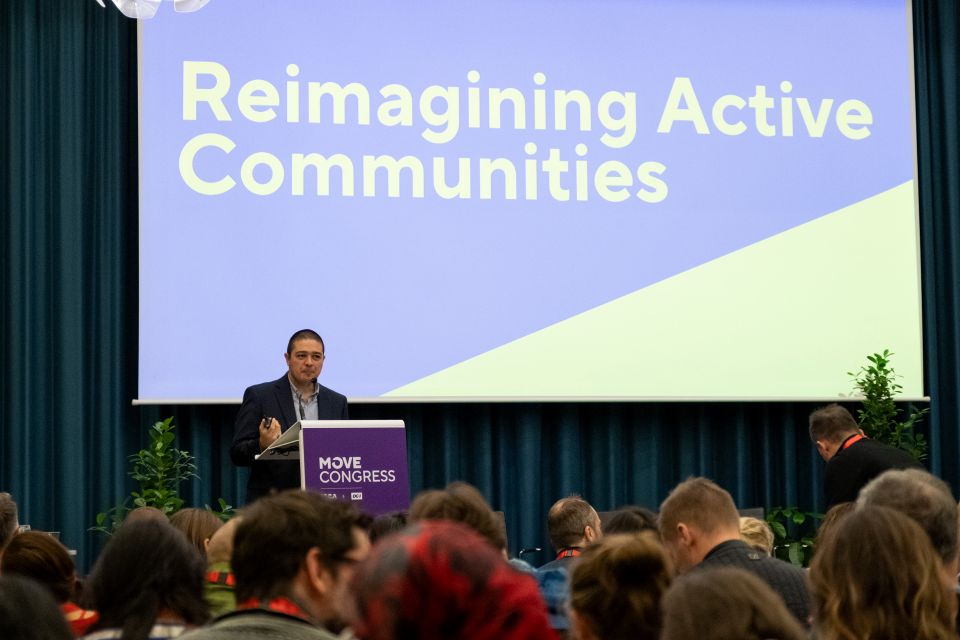
Much buzz surrounds the concept of #activating communities. But what initiatives are truly making a difference? And which strategies can help us move beyond traditional success metrics towards a broader vision of community transformation?
On its first full day, the MOVE Congress explored new and imaginative ways in which sport and physical activity can inspire and transform communities. The session drew on the new ‘Sport for Changemaking’ initiative from the global Ashoka network, which aims to ensure that each sporting activity is a nurturing experience and all those involved in sport see themselves as contributors to a common good.
Moderated by Sport for Changemaking’s Co‑Lead Héctor Moyeton, the panel featured DGI Senior Advisor Simon Rømer Roslyng, London Marathon Foundation Funding Head Helen Killingley, Cycling Without Age CEO Ole Kassow, and Dr Louis Moustakas, Professor of Sports Management and Sports Sociology at Kufstein University of Applied Sciences.
Ole Kassow grew up with his father in a wheelchair, which allowed him to witness first‑hand the mental health impacts and marginalisation that can stem from a lack of mobility. In most cases, he emphasised, these issues are not down to individual failings – they can be addressed through relationships, community and a meaningful framework. “If we design cities that are not good for grandmothers, they are not good for anyone,” he said
Cross-generational Connections
Kassow’s childhood experiences shaped his life’s work in social participation through the movement he founded, Cycling Without Age. Now a global movement, the organisation targets older adults who lack mobility. Volunteers — known as “pilots” — who take them out on specially‑designed trishaws, also benefit from cross-generational connections and tapping into a basic human need for belonging and relationships. These rides lead to significant increases in feelings of happiness and well‑being among both the riders and pilots, he pointed out.
A key method of tackling sport’s systemic barriers in London, Helen Killingley explained, has been to work with landowners to activate under‑used spaces such as disused fountains and car parks, and co‑design facilities with young local people. The most important key to long term change, she argued, is that facilities and initiatives “needs to be designed by communities, not for communities.”
She also cited the More Ball Games campaign — which focused on the removal of outdated and restrictive “No Ball Games” signs in public spaces — as having a significant effect in bringing communities together. “We do not need to prove again and again what sport brings” she said. “We need to create the space and the trust.”
“Not all sporting experiences are positive,” Louis Moustakas observed. “But we can recognise when they are done well. When they are, people come closer and bridge the distance created by the external narrative. Rather than being ‘the guy from out of town’, you become ‘the guy from the running group’.
“Traditional competitions and performance metrics need to be challenged,” he said. “Teaching and having fun are more important than winning. All too often we are so busy trying to please everyone. We fail to advocate for change because we fear upsetting the funders.”
Trying to Please Everyone
“Policymakers say they don’t have the money — but the money is there, and we are choosing not to go there for fear of upsetting people” he added. “Don’t rely on the generosity of corporations — tax them.”
The benefits of volunteering in sport are clear in Denmark and the wider Scandinavian region, Rømer Roslyng said. “Those who volunteer show significantly more tolerance in general, have a higher trust in institutions and more of an open mind” he pointed out.
In Denmark, he said, community sport is largely volunteer-based, meaning that costs are distributed much more evenly across the country. Around 40% of Danes have done voluntary work in the past year, encouraging a culture that brings encourages local engagement and social cohesion. This in turn builds civic responsibility and community spirit: empowered people become active citizens, who look out for their neighbours and trust each other. The civil-society sector plays a vital role in this ecosystem.
In conclusion, the panel agreed that innovative, out-of-the-box thinking and different funding models are needed to allow the grassroots and community sports sector to thrive. Traditional funding methods – grants with vast reporting obligations or commercial sponsorships with strings attached – can stifle the “bottom-up” grassroots involvement that is needed #activate communities.


Vesterbrogade 6D
1620 Copenhagen V
Denmark
Copyright © 2025 International Sport and Culture Association. All rights reserved.
GDPR | Site Map
Vesterbrogade 6D
1620 Copenhagen V
Denmark
Vesterbrogade 6D
1620 Copenhagen V
Denmark